
The Brutal Truth About Affiliate Marketing
Someone on YouTube just made $5,000 from affiliate marketing in 30 days. At least, that is what the thumbnail says.
Meanwhile, you have posted links, written content, joined Amazon Associates, checked your dashboard seventeen times, and earned exactly enough to buy half a coffee.
I understand that feeling because I lived it.
TL;DR: The honest truth
- Affiliate marketing can make money, but it rarely creates overnight wealth.
- An audience, trust, useful content, and patience matter more than posting hundreds of random links.
- It took me two years to earn my first affiliate dollar, but that first dollar showed me how the system really works.
Can You Really Make Money With Affiliate Marketing?
Yes, affiliate marketing can make real money, but it normally grows through trust, useful content, consistent traffic, and time—not through a secret shortcut promising thousands of dollars next month.
| What the videos promise | What usually happens | What worked for me |
|---|---|---|
| Post a link and make money immediately. | Most links receive few clicks because nobody has a reason to trust them. | Create content that solves a specific problem before mentioning a product. |
| Earn $5,000 in your first 30 days. | Many beginners earn nothing during their first few months. | Treat the first stage as building an audience and learning what people need. |
| Copy a profitable niche and repeat the formula. | Copied content disappears into a sea of identical posts. | Use personal experiences, honest opinions, and examples nobody else can copy. |
| One passive-income trick changes everything. | Income normally depends on many connected pieces working together. | Volume 1 explains the foundation, while Volume 2 focuses on building and improving the complete system. |
Why I Am Tired of “Get Rich Fast” Affiliate Videos
I keep seeing YouTube videos about affiliate marketing, Amazon Associates, online partnerships, and passive income.
The thumbnails usually follow the same recipe: a shocked face, a giant dollar amount, several red arrows, and a dashboard showing enough money to make everyone question their career choices.
“I Made $5,000 in 30 Days!”
“Copy This Method Before It Is Too Late!”
“Earn Money While You Sleep!”
I am not saying that nobody has ever earned $5,000 in a month. Some people absolutely have.
The missing part is everything that happened before those 30 days.
Maybe they already had a YouTube audience. Maybe they owned a high-traffic website. Maybe they spent years learning SEO, creating videos, building an email list, or becoming recognizable within a particular niche.
Sometimes the affiliate income is not even their main income.
I have met influencers who talk publicly about getting rich through affiliate marketing. Behind the scenes, much of their money actually came from YouTube advertising revenue, sponsorships, courses, or the attention generated by videos about making money.
That does not automatically make them dishonest. But leaving out the full picture can make beginners feel as though they are failing at something that was never as easy as advertised.
It Took Me Two Years to Make My First Dollar
Here is the part that would create a terrible YouTube thumbnail: it took me two years to earn my first dollar from affiliate marketing.
Two years.
Not two hours. Not two days. Not “$10,000 while sleeping on a beach.”
For a long time, I thought affiliate marketing meant finding products, copying the links, and placing them wherever people might see them.
I had links. I had content. I had hope. I also had almost no commissions.
The mistake was simple: I was thinking about the link before thinking about the person clicking it.
People were not waking up excited to support my affiliate dashboard. They were trying to solve a problem, compare two choices, avoid wasting money, or find something that genuinely made life easier.
Once I understood that, everything started to make more sense.
The First Dollar Changed How I Saw Everything
My first affiliate dollar was not impressive financially. Nobody was calling Forbes.
Emotionally, though, it was huge.
It proved that a stranger had discovered my content, trusted my recommendation, clicked the link, and completed a purchase.
That tiny commission showed me that affiliate marketing was not fake. My original approach was simply incomplete.
Once one person converts, the process can be studied. Which article brought them in? What problem were they solving? Why did they trust that recommendation? Could another useful piece of content help someone with the same problem?
That is when affiliate marketing stops feeling like gambling and starts becoming a system.
What Actually Makes Affiliate Marketing Work?
The strongest affiliate content helps people make a decision they were already considering. It does not force a product into an unrelated conversation and pray for a commission.
1. Trust Comes Before the Link
I used to believe more links would create more opportunities to earn.
In reality, more links without trust usually create more things for people to ignore.
A useful review explains the good parts, the weaknesses, who the product suits, and who could probably save their money.
Strangely enough, admitting that something is not perfect can make a recommendation much stronger. People can tell when every product is suddenly “life-changing.”
2. Helpful Content Beats Constant Promotion
The content that brought me the best results did not feel like an advertisement.
It answered a real question.
Someone searching for the best website builder does not need another person screaming, “Use this one!” They need to understand the price, limitations, learning curve, design options, and which platform fits their situation.
The affiliate link becomes useful only after the content has reduced confusion.
3. Search Traffic Can Keep Working After You Log Off
Social media can create attention quickly, but it can also forget a post before I finish celebrating it.
Searchable content behaves differently.
A useful YouTube video, blog article, comparison page, or Pinterest post can continue appearing when someone searches for the same problem weeks or months later.
This is the closest affiliate marketing comes to passive income. The work happened earlier, but the content remains available when the right person needs it.
4. One Piece of Content Can Become Many
One lesson took me far too long to discover: I did not need to create every idea from zero.
A detailed article could become a YouTube video. The video could become several Shorts. The main points could become Pinterest pins, an email, a Facebook post, and a simple comparison chart.
Suddenly, one afternoon of work had more than one chance to reach an audience.
5. The Numbers Tell a Better Story Than Motivation Does
Motivation is wonderful until it disappears on a Tuesday afternoon.
Numbers are less dramatic but much more helpful.
Traffic shows whether people are finding the content. Clicks show whether the recommendation feels relevant. Conversion rates show whether the offer matches the audience.
When something does not work, the answer is not always “post more.” Sometimes the title is attracting the wrong person. Sometimes the link appears too early. Sometimes the product simply does not match the problem.
Why Most Beginners Make Nothing
Most beginners do not fail because they are lazy or incapable.
They fail because the online version of affiliate marketing removes all the slow, unglamorous parts from the story.
Nobody puts “I spent six months understanding my audience” across a thumbnail. It does not look exciting next to a Lamborghini.
But those quiet months matter.
The early stage often involves publishing content that receives almost no attention, choosing products that never convert, rewriting titles, improving descriptions, testing different platforms, and wondering whether the entire internet has personally decided to ignore you.
I know that stage very well.
The advantage is that each mistake creates information. Over time, the random experiments begin forming a repeatable process.
The Two-Book System I Wish I Had at the Beginning
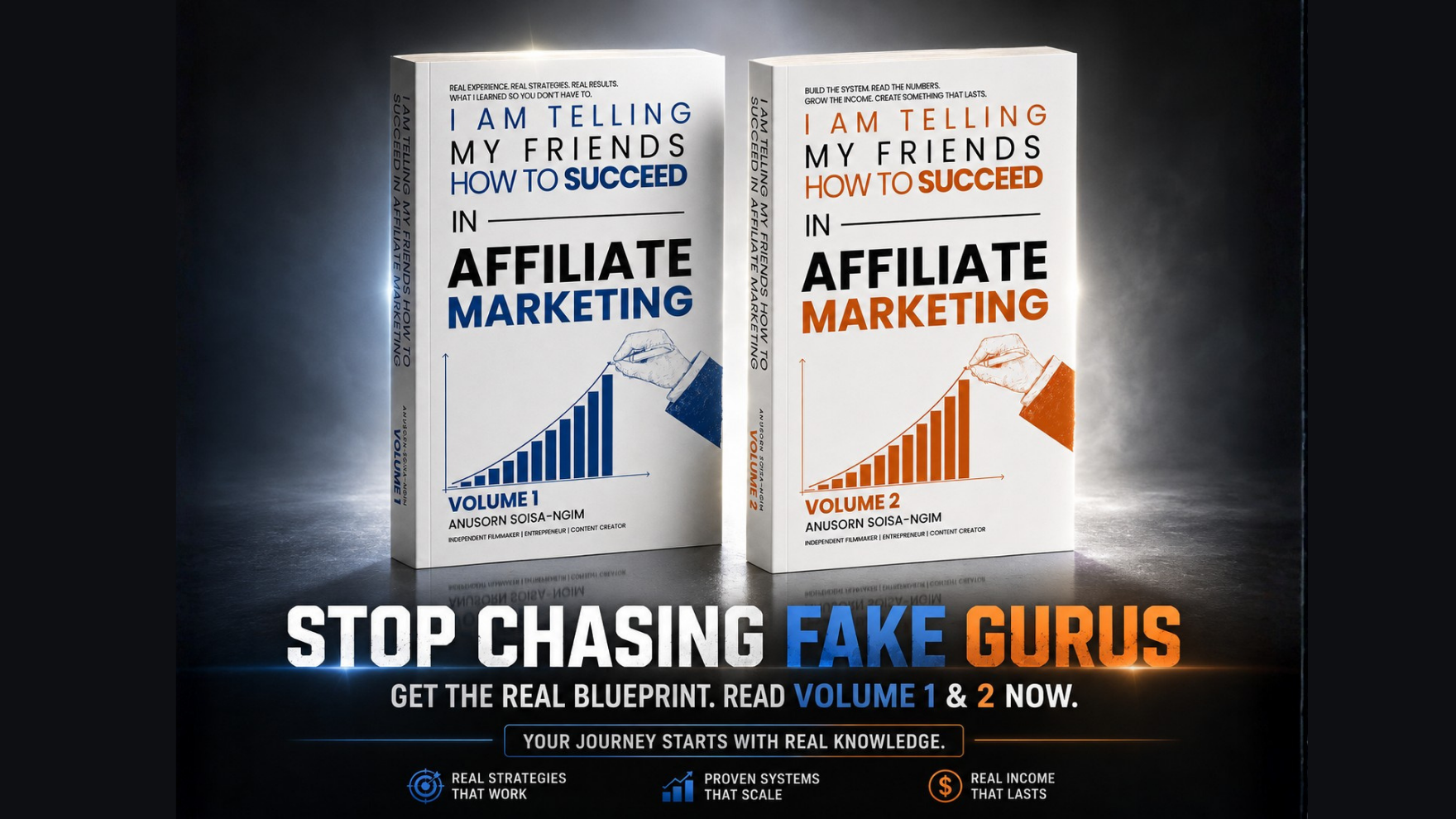
I wrote I Am Telling My Friends How to Succeed in Affiliate Marketing because I wanted to explain affiliate marketing the same way I would explain it to someone I genuinely cared about.
No rented sports car. No overnight millionaire fantasy. No mysterious secret that disappears after the checkout page.
Volume 1 focuses on the foundation: trust, audience understanding, valuable content, profitable niches, honest recommendations, and building a brand people want to follow.
I Am Telling My Friends How to Succeed in Affiliate Marketing — Volume 1
Volume 2 continues into the practical system: stronger hooks, audience retention, YouTube SEO, thumbnails, descriptions, analytics, content repurposing, conversion tracking, and multiple income streams.
I Am Telling My Friends How to Succeed in Affiliate Marketing — Volume 2
I created them as the honest roadmap I could not find when I started—the complete story, including the boring parts that actually make the exciting results possible.
Affiliate disclosure:
Some links in this article are affiliate links. If you make a purchase through one of them, I may receive a small commission at no additional cost to you.
How Long Does Affiliate Marketing Take?
There is no universal timeline because everyone starts with different skills, audiences, traffic sources, niches, and available time.
Someone with an established YouTube channel could earn a commission quickly. Someone starting with no audience may spend months creating content before receiving consistent clicks.
My own first dollar took two years.
That does not mean everybody needs two years. It means I would rather share an uncomfortable true number than invent a beautiful fake one.
Once the system begins working, growth can become surprisingly powerful. Older content continues bringing traffic, new content improves faster, and each useful recommendation adds another possible source of income.
Is Affiliate Marketing Worth It?
Affiliate marketing can be worth it for people who enjoy creating helpful content, sharing honest experiences, studying audience behavior, and building something over time.
It may feel miserable for someone expecting fast money from posting random links.
The real opportunity is not getting rich overnight. It is creating a library of useful content that can keep connecting people with products, services, and solutions they already need.
That is slower than the guru version.
It is also far more real.
Affiliate Marketing FAQ
Can a beginner make money with Amazon Associates?
Yes, but simply joining Amazon Associates does not create traffic or trust. Beginners usually have a better chance when they publish useful reviews, comparisons, tutorials, and problem-solving content around products their audience already wants.
Can affiliate marketing make you rich fast?
It is possible to earn significant money, but fast wealth is not the normal beginner experience. Most sustainable affiliate income grows from an established audience, searchable content, trusted recommendations, consistent traffic, and repeated improvement.
How much money can affiliate marketers make?
Earnings can range from nothing to a full-time income and beyond. The result depends on traffic, commission rates, product prices, audience trust, conversion rates, niche demand, and how effectively the content helps people make decisions.
The Truth Is Slower—but Much Better
I understand why those “make money fast” videos are attractive. When money is tight, waiting patiently is not exactly the dream answer.
But I care too much about people to promise that one link, one video, or one secret platform will change everything next month.
Affiliate marketing is real. The income can become real too.
It begins with helping one person, earning one click, making one honest recommendation, and eventually seeing that first dollar appear.
Mine took two years.
Once it finally happened, I knew I was no longer chasing a fantasy. I was building something that could grow.
That is the brutal truth about affiliate marketing—and honestly, it is much more hopeful than another fake promise.

 Aam Anusorn Soisa-ngim
Aam Anusorn is an independent filmmaker and storyteller with a decade of experience in the industry. As the founder and CEO of Commetive By Aam, he has directed and produced several acclaimed films and series, including the popular "Till The World Ends" and "#2moons2." Known for his creative vision and determination, Aam prefers crafting original stories that push the boundaries of traditional genres, particularly in the BL and LGBTQ+ spaces. Despite the challenges and pressures of working in a competitive field, Aam’s passion for storytelling drives him to explore new ideas and bring unique narratives to life. His work has garnered recognition and support from prestigious platforms, including the Tokyo Gap Financial Market. Aam continues to inspire audiences with his innovative approach to filmmaking, always staying true to his belief in the power of original, heartfelt stories.